

You’re halfway through a swim when you glance up and notice the neighbor’s second-story window has a perfect view of the pool deck. Suddenly, your relaxing backyard retreat feels a little more public than you’d planned.
A privacy screen for a pool enclosure can help with certain sightlines, but it isn’t a privacy wall, and it comes with a very real airflow trade-off. The sweet spot is usually a carefully chosen band of pool enclosure privacy screen on exposed lower panels, with open mesh above.
What “Florida glass” privacy screen actually is
Often called Florida glass, privacy screen is fiberglass mesh, typically an 18x14 weave, with a translucent vinyl layer laminated onto it. The finish looks frosted rather than solid.
Light still comes through, but clear detail does not. Shapes and movement may remain visible, so it’s best thought of as visual screening, not one-way glass or a solid barrier.
That vinyl layer closes the mesh openings. The covered area has essentially zero openness and gets no breeze. This is the trade-off that should guide the layout.
Want to compare screen options for your enclosure? Request a free estimate or call 813-447-0431.
Where privacy screen belongs: lower panels, not everywhere
For most enclosures, a practical approach is to install privacy screen on the lower three to four feet of selected vertical panels, roughly the band at deck level. Keep standard or solar mesh on the upper panels and roof.
That hybrid layout can give you privacy where people are most likely to look in, while keeping breeze and a more open view above. Placement depends on the enclosure, sightlines, and prevailing conditions at your home; covering every wall is rarely the simple upgrade it sounds like.
Never on the roof. This one is not negotiable.
Privacy screen should never go on the roof of your enclosure. Not as a sun fix, not as a leak fix, not because it looked good on a wall.
It is not a rain barrier, so it will not keep water out. Worse, the vinyl laminate traps water and debris against the framing instead of letting them drain and dry. That trapped moisture is how mold and mildew get a foothold along your roofline, and it turns an upgrade into a maintenance problem hanging over your head.
The bigger issue is structural. Your cage was engineered for the specific screen that was originally installed on it. Swap in a different material, especially a heavier, non-breathable one on the roof, and you have changed the load and the drainage without changing the engineering that supports it. In a real wind event, that is a good way for a cage to fail instead of flex.
If someone tells you privacy screen on the roof will solve a leak or a heat problem, ask them to put it in writing and get a second opinion before anything goes up there. On a wall, a lower band can be a thoughtful choice. On a roof, it is a risk.
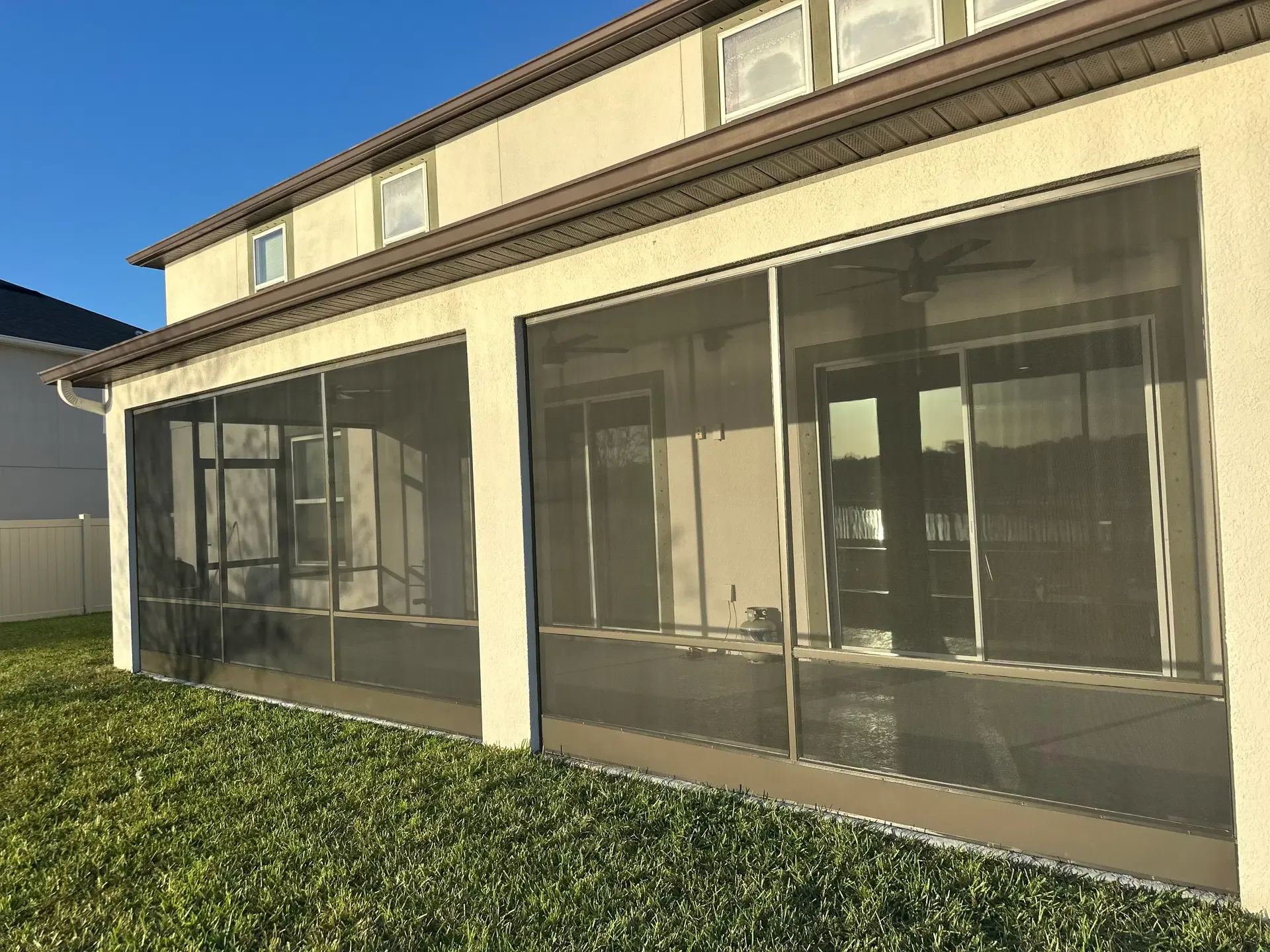
Most privacy screen for pool enclosure conversations start with a handful of familiar sightlines. A lower privacy band can earn its keep when you have:
- A neighboring two-story window overlooking the pool deck.
- A close side yard or narrow lot where outdoor spaces sit near one another.
- A corner facing a street or walking path where people regularly pass.
- Lawn clippings, mulch, irrigation overspray, or splash-back that tend to blow in at deck level.
- Pets, furniture, and string trimmers putting extra wear on the lowest panels.
The material’s added toughness can be useful in that busy lower zone, too. It isn’t indestructible, but it may suit a panel that sees more contact than the mesh overhead.
What privacy screen does not do
Let’s keep this clear, because a premium upgrade should come with honest expectations:
- It is not a privacy wall. Light comes through, and you may still notice shapes or movement.
- It is not a rain barrier. Water will not be kept out, and on a roof the trapped moisture invites mold along the framing.
- It is not a hurricane or wind barrier. It does not improve the frame’s structural rating or storm protection.
- It is not a security product. It does not secure the enclosure or prevent someone from entering.
- It is not a pool safety barrier. It does not replace or satisfy pool barrier requirements.
- It does not block an overhead view. A neighbor looking straight down from a second story can still see into the enclosure. Upward angles remain exposed.
If the main concern is someone looking down from above, lower-panel screening may soften views from the side, but it will not solve that particular sightline. It’s better to know that before choosing a material.
The trade-offs to consider before choosing it
Privacy screen blocks breeze where it’s installed. That side of the enclosure may feel warmer and take longer to dry, which matters in Tampa Bay humidity. A lower band keeps the change more localized than covering every panel, but it is still a change you’ll notice.
The vinyl surface can haze or cloud with age. It may also show dust and pollen more readily than open mesh. As with any pool cage maintenance, gentle is the operative word: use mild soap and a soft brush, then rinse carefully. Pressure washing is a bad idea for screen materials. Our guide explains why pressure washing can quietly damage pool-cage screens.
Privacy screen also costs more than standard mesh because of its manufacturing. For a broader look at available materials, visit our pool and patio screen types page. If reducing sun and glare is your priority, solar screen mesh may be a better conversation; it has different visibility and airflow trade-offs.

Privacy screen and kick plate are not the same thing
The lower band may already have a kick plate. That is a solid aluminum panel. Privacy screen is mesh with a vinyl laminate: it filters light and sightlines rather than forming a solid panel. One is not a different name for the other. See our guide to what a pool-cage kick plate does.
Why installation during a rescreen makes sense
Privacy screen is usually easiest to plan when you’re already arranging pool enclosure rescreening or lanai screen replacement. The panels are coming down for the work, so you can decide on the exposed sides and lower-band height as part of one coordinated project, not revisit the enclosure for a second job later.
A professional installer can review sightlines, existing panels, frame condition, and the material’s fit. The goal is a neat, tight and secure fit that suits the enclosure, using mesh matched to what the cage was engineered to carry. One thing we will not do is put privacy screen on a roof. If that is what you were hoping for, we would rather explain why than sell it to you.
Lily Luxe Rescreen uses high-grade mesh, and we use stainless steel fasteners where appropriate to the project. The dual warranty and applicable terms should be confirmed in your estimate.
Our crews also take care to organize removals and materials, keep the yard tidy, and protect landscaping as work progresses. The finished result should feel polished, and the worksite should be treated with care along the way.
If your enclosure needs new screens, we can discuss whether a privacy band makes sense for your layout. Request a free estimate or call 813-447-0431.
Check HOA or ARC requirements before changing visible screens
In many deed-restricted Tampa Bay communities, changing visible screen material is an exterior appearance change. Get written Architectural Review Committee (ARC) or HOA approval before installation, especially for street-facing panels.
Ask the association what it needs for review. Depending on its process, that may include the proposed material and color, panel locations, product information, a project description, or contractor details. Keep the application and written decision with your project records. A county permit exemption, where applicable, does not cancel HOA approval requirements.
Our Tampa Bay HOA approval guide can help you understand the separate approval steps and documentation to check.
Local help for a more comfortable backyard
Lily Luxe Rescreen LLC is locally owned and serves homeowners in Lutz, Land O' Lakes, Odessa, Trinity, New Tampa, South Tampa, and Wesley Chapel. Whether you’re looking for a pool enclosure privacy screen, planning lanai screen replacement, or searching for rescreening services near me, we’ll help you weigh privacy, breeze, and view before you choose.
A good plan is specific: screen the sightline that bothers you, keep open mesh where you want air and views, and understand what the material can, and cannot, do.
Ready to talk through your enclosure? Request a free estimate or call 813-447-0431.
Lily Luxe Rescreen LLC is a Florida Certified Specialty Contractor, SCC131154765.